
I’ve done time as a soccer mum. Our home has a collection of tacky plastic trophies to show for it. (Although I still can’t spot offside play.)
Like most things, the World Cup has an intriguing history. I mean the actual cup — the prize that symbolises victory. Trophy-making is a pretty obscure art form, but it gets moments of glory.
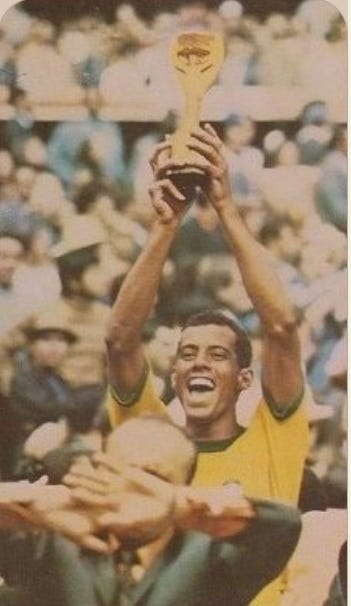
The word “trophy” is descended from the Greek “tropaion”, which referred to property captured in battle. That included weapons, standards, captives… even body parts.
(Aren’t you glad we use cups and statues?)
The first World Cup competition was held in Uruguay in 1930. Only 13 teams competed. The trophy (pictured above) was designed by a French sculptor and medallist named Abel Lafleur (1875-1953). By medallist, I mean that Lafleur was a maker of physical medals. But interestingly, he was actually a competitor in the Olympics, and not as an athlete. In 1932 the summer Olympics had a sports-themed arts category, and Lafleur entered the ‘Sculpturing, medals and relief’ event.1 His entry was a ‘football plaque’.
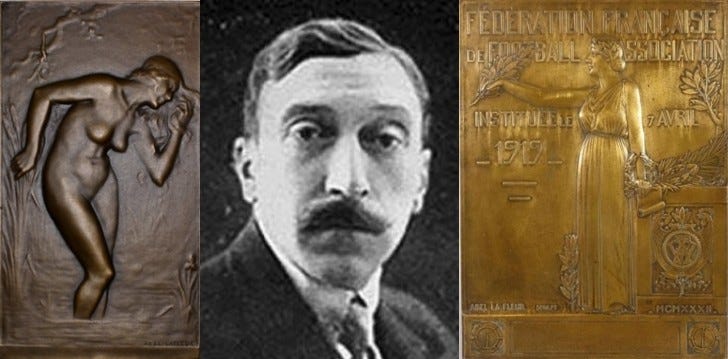
Personally, I’m not surprised his plaque didn’t win. Lafleur is said to have been influenced by Art Nouveau co-founder Jules-Clement Chaplain, another medallist. You can see that in the graceful lines of ‘La Bain’, above left. But by 1932 art styles were changing. Cubism had made an impact, and the woman on the football plaque is kind of clunkier and less fluid.
Ditto the figure of Nike, goddess of victory, on the first World Cup. She’s inspired by the famous winged Victory of Samothrace in the Louvre, as is the Rolls Royce statuette. But Lafleur’s Nike is much more square and static. (Still better than body parts!)
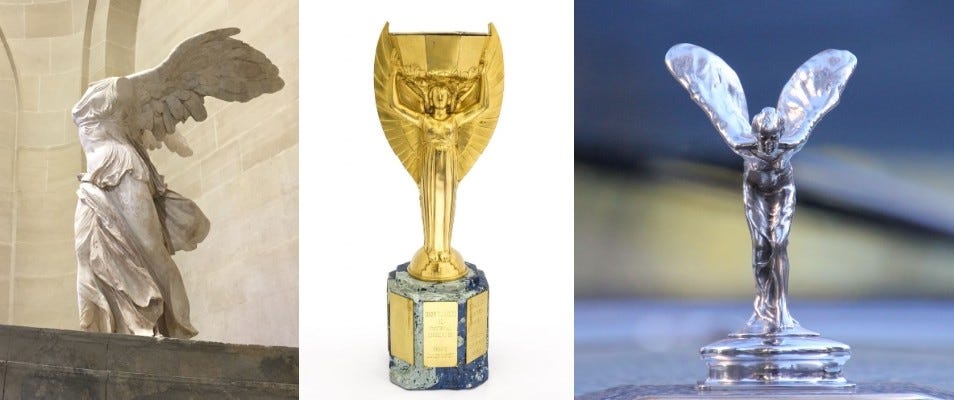
The Coup du Monde was 35cm (14”) high and weighed a hefty 3.8kg (8lb 6 oz). With that amount of metal in it, the trophy was not solid gold. Instead it was gold-plated silver, with a lapis lazuli base. It became known as the Jules Rimet cup, after the man who organised the first competition.


What happened to the Jules Rimet cup?
Why am I saying ‘was’? Isn’t there still a World Cup trophy?
Not the same one. When Brazil won the World Cup competition for the third time in 1982, FIFA regulations let them have the cup for keeps. But it’s more complicated and controversial than that. The cup lived a risky life.
First Theft Attempt
In 1938 the World Cup was won by Italy. So that’s where the cup was, stored in a Roman bank, when the Nazis occupied Italy. The Vice-President of the Italian Football Federation did not trust the treasure-hunting Nazis, so he withdrew the Jules Rimet cup from the bank and tucked it in a shoebox under his bed. The Gestapo did come looking for the cup. But somehow the Italian footballer put them off the scent. (You really wonder how. A lot of grappa, to help distract them?) FIFA didn’t get the cup back until 1947.
Second Theft Attempt
In 1966 the trophy was on exhibition in Westminster, UK. While Sunday church was on downstairs, thieves jemmied open a cabinet, and walked out with the cup. Scotland Yard launched a massive investigation. A ransom demand arrived for £15,000. The police arrested the petty crim who turned up to collect the ransom. But he didn’t have the cup.
Panic stations at FIFA. The English FA secretly ordered a replica made.
Then, amazingly, a London dog with the cute name of Pickles found the trophy under a laurel bush, while out on a walk. Nobody knows how the cup got there. Anyway, the dog got FIFA out of its pickle, you might say. Or it earned its laurels 😁.
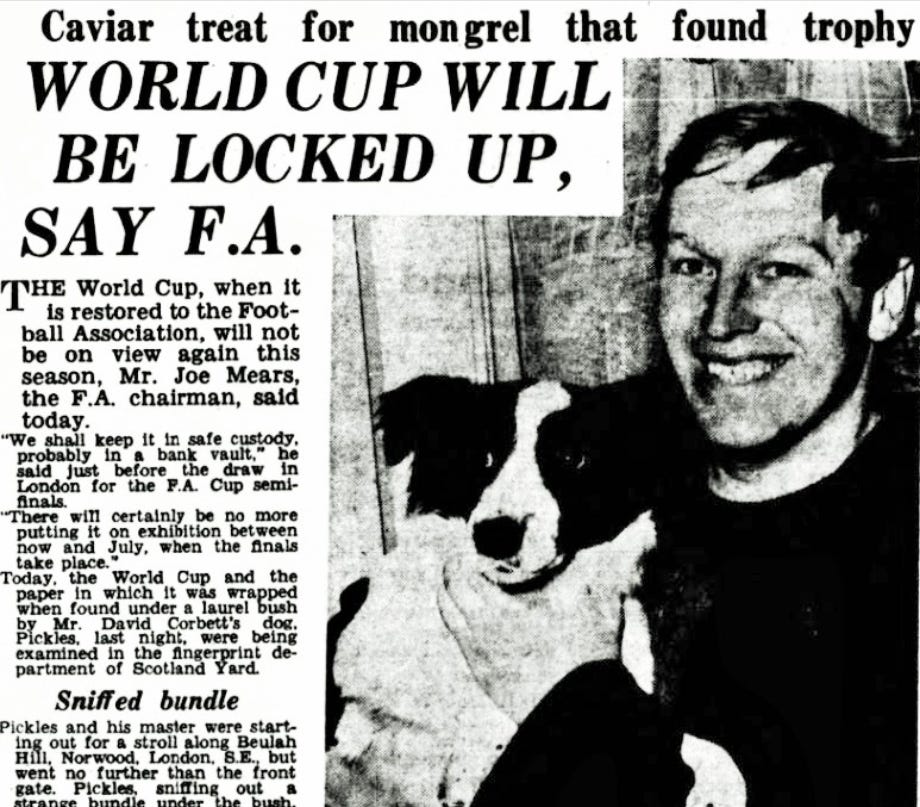
England went on to win the 1966 tournament. But was the cup kissed by the English captain the real thing? Or the replica? Nobody is sure.
Third and Final Theft
After Brazil’s 1982 triumph, the Jules Rimet cup went on display in that country’s Football Confederation headquarters. Not for long. Once again, the temptation was too great, and security too slack. In 1983, another locked cabinet was easily defeated by a crowbar. This time, the cup wasn’t recovered. Although the base turned up in FIFA’s basement three decades later (in 2015).
Some think the cup has been melted down. But the cup’s silver is worth only about US$8,000 in today’s prices. I wonder if that comparatively small amount was worth the risk to the thieves. Perhaps it’s sitting in a cupboard, in a subúrbio somewhere in Brazil. Mostly forgotten, but sometimes fondly dusted off, like my kid’s trophies. Because in the end, it’s what they stand for that matters most. The object is a symbol of all that effort, of the triumph of teamwork, training and talent over mud, cold and a worthy opponent. It’s the human element that gives the trophy its real value. Victory and glory appeal to us deeply. Sometimes more than our comfort.
That’s it from me this month. I don’t generally write a lot about sport. It gets more airtime than I’m interested in already. Imagine if your favourite author or artist got half the coverage your local football team does… But I enjoy the excellence and energy of the World Cup. And I like the stories in sports history. (See here for Surprising stories from the Early Olympics and the Olympic memorabilia in my backyard.) Hope you do too.
You can post a like or a comment. Or send this piece on to someone else.
Here’s hoping for lots of brilliant goals, whoever hoists the cup.
He’s listed on the Olympedia website.