
You probably don’t think of Australia as a radical place. Unlike Europe and America, we’ve had no revolutions to speak of. No civil wars. (Unless you count colonial massacres and Aboriginal resistance, neither then officially recognised.) That doesn’t mean nothing happened here! Immigrants to Australia have long been a hodgepodge of adventurers, opportunists, and hopefuls. Some crossed the world willingly, others not so. Mostly law-abiding, but not always.
I recently went on a tour of Melbourne’s handsome, historic, union headquarters. (Thank you to unionist Lily, who led the tour.) Inside it’s a bit of a rabbit warren, marked and shaped by generations. I discovered more to labour movement history than I expected.
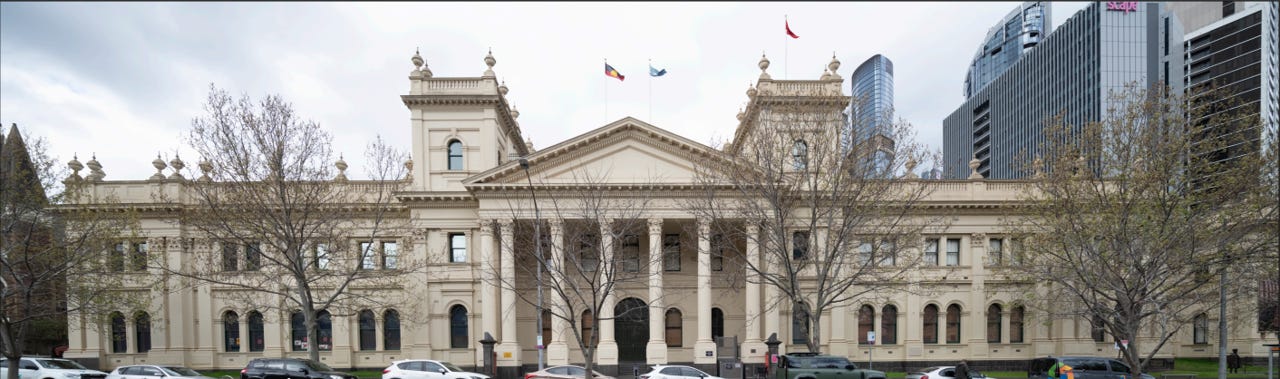
Notice the eight pillars at the front of the building — one extra squeezed in each side. The portico didn’t need that many pillars. So why are there eight of them?
A World First
Melbourne’s Trades Hall is the world’s oldest trade union building still in use. It’s history starts with a world first. In 1856, during the hectic Gold Rush building boom, local stonemasons downed tools. They wanted better working conditions, and they got them. Melbourne workers were the first in the world to be granted an 8-hour day.
8 hours to work,
8 hours to play,
8 hours to sleep,
And eight bob a day.1
Slogan of the 1856 ‘888’ movement
After this success, unions grew in number, and wanted somewhere to meet. So they raised money and built themselves a venue, on the site of the current Hall. The first hall was built of wood with an iron roof. When it was rebuilt in 1875, the original Oregon timbers were so good that they were recycled into the current floors.
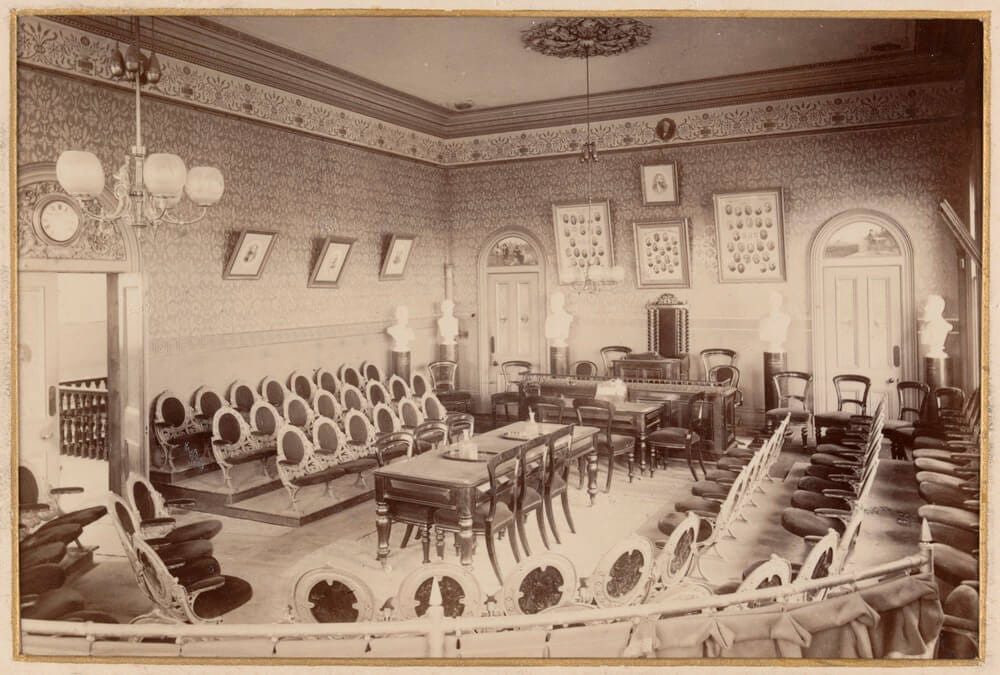
The Council meeting room, or ‘people’s parliament’, was said to be ‘the finest room in the colony’ by the The Argus newspaper, when completed in 1884. The Trades Hall Council calls it ‘the living, beating heart of working Melbourne’.
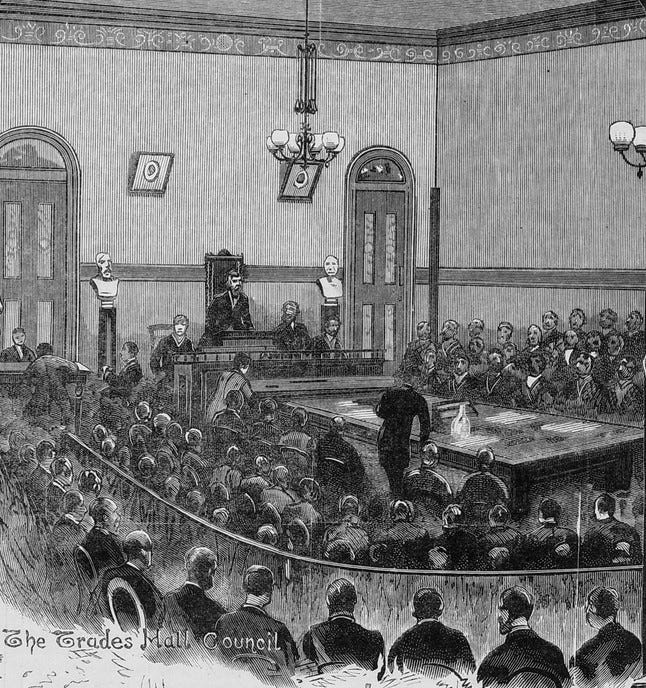
The building is usually called ‘Trades Hall’, but it’s full name, surprisingly, is the ‘Trades Hall and Literary Institute’. Sounds a bit pretentious. However, it turns out the tradespeople of the nineteenth century were definitely what we’d call aspirational. They were interested in more than wages and working conditions.
The Hall was envisaged as:
A place where workmen may their minds engage
To useful purpose o’er the printed page…
A hall where wife and children may be found
To listen to a concert of sweet sound.2
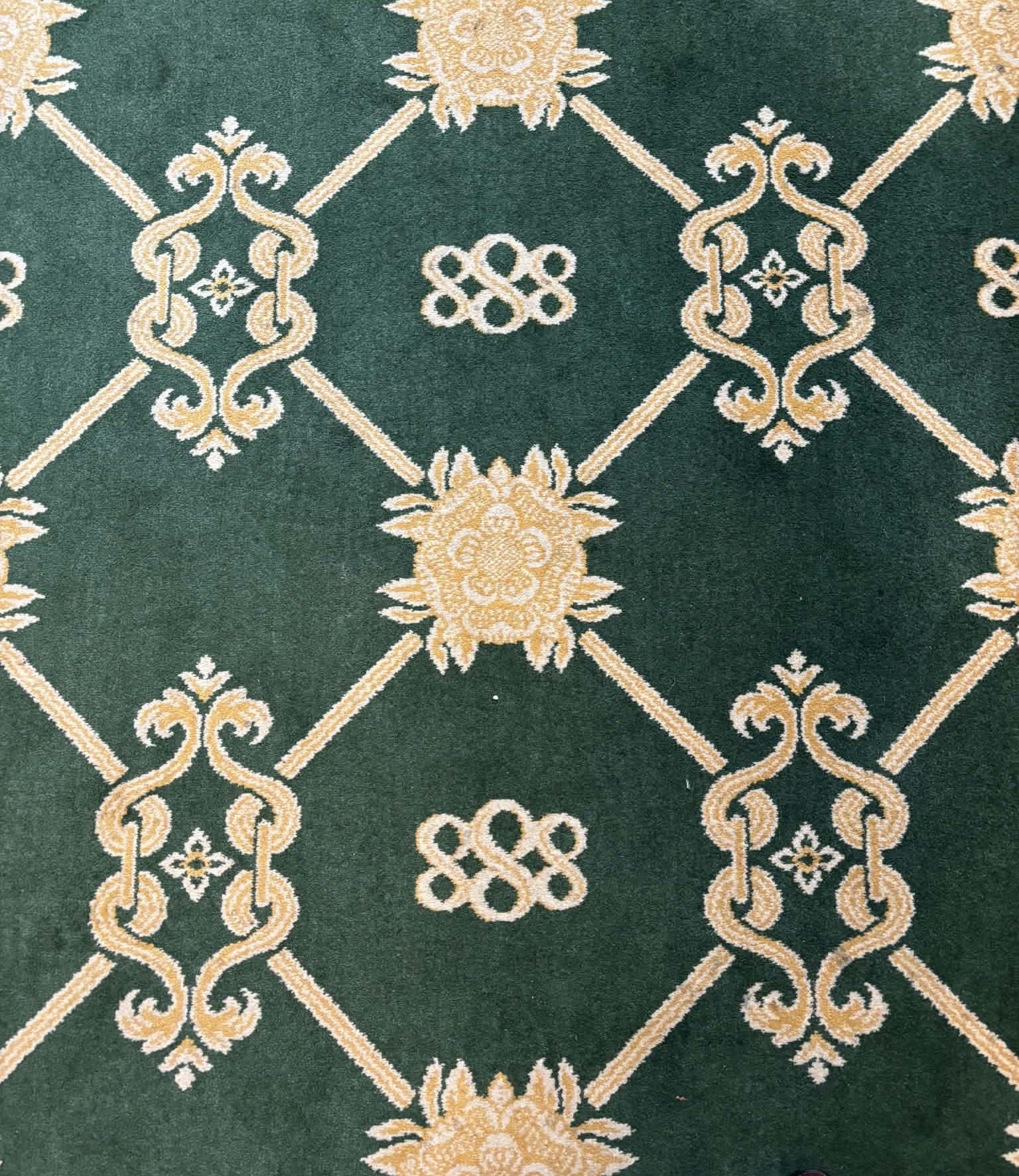
Even the Hall’s carpet reflects the unions’ commitment to what they call ‘bread and roses’ – physical and spiritual sustenance. (If you thought ‘spiritual’ was my word, it’s actually Trades Hall Council vocabulary. ‘Bread and roses’ was an expression popularised by American suffragettes.3)
‘Knowledge is Power’
The Hall hosted a library, and an ‘Artisan’s School of Design’ from 1869 onwards.
The really great prize in relation to culture was in the motto placed up in the room, “Knowledge is Power”. Power was the great prize in life to those who pursued knowledge—the power of using life nobly and well for themselves, and of helping their fellow creatures to do the same.
W.M.K. Vale, from his speech on prize night, March 1884, at the Artisans School of Design. Argus 1 Mar 1884 https://trove.nla.gov.au/newspaper/article/11846928
The Trades Hall vision for its Design School seemed to be fairly pragmatic and not overly ambitious:
[Mr Vale] did not mean to say that that school could make great painters, architects or engineers, but it furnished a pleasant way of spending time during one night in the week... The object was to teach the students drawing which would help them in the business of life....
Mr Vale wanted parents to share his view (which suggests that at least some of them had grand designs for their children). He urged them ‘not to desire rapid progress in drawing on the part of their children. There was too much a tendency on the part of pupils to rush into castles and landscapes. Parents should be quite satisfied if, during the first year, their children acquired the art of drawing a straight line.’
Personally I would not want to be in Mr Vale’s class. Straight lines sound very boring. Castles and landscapes are more my thing! Or they would be if I was any good at drawing.
Despite Mr Vale’s low expectations, some of the school’s students were more than good at drawing. One of its first students was a Fred McCubbin, teenage apprentice to a carriage-builder:
… the following Friday evening saw me off to the Trades Hall School of Design, Lygon Street, Carlton, sitting on the stairs of the old wooden building waiting for eight o’clock when the school opened… Well I was in seventh heaven, I had really got into the palace of Art. It was a joy all day while trying to knock out rusty bolts and help tire wheels and paint and putty the same to let my mind wander over the charms of painting.
At the school McCubbin became friends with a young photographer’s assistant named Tom Roberts. Roberts went off to Europe for a few years, where he was influenced by Impressionism and painting en plein-air. On his return to Australia in 1885, he and McCubbin went on ‘artist camps’ in the area around Melbourne. Some were in Heidelberg, just down the road from me.
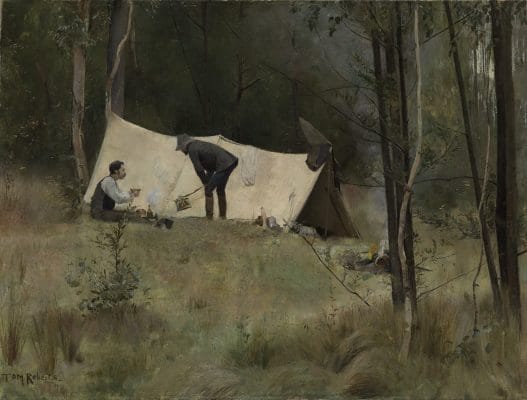
McCubbin, Roberts and other late Victorian painters are now known as the ‘Heidelberg School’. They created iconic images, capturing the colour and character of the soon-to-be-independent colonies.
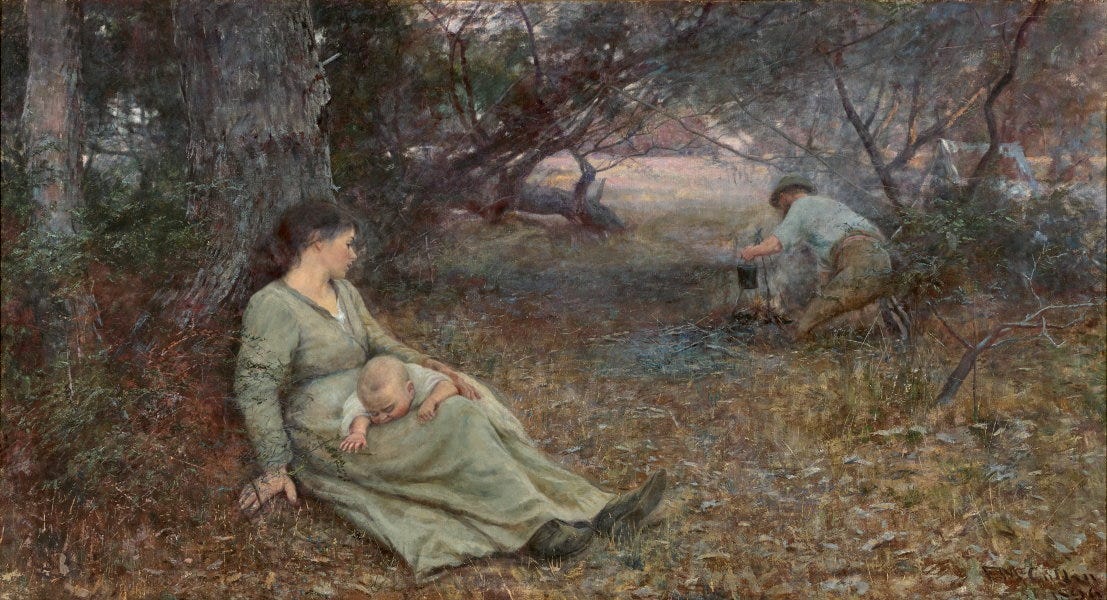
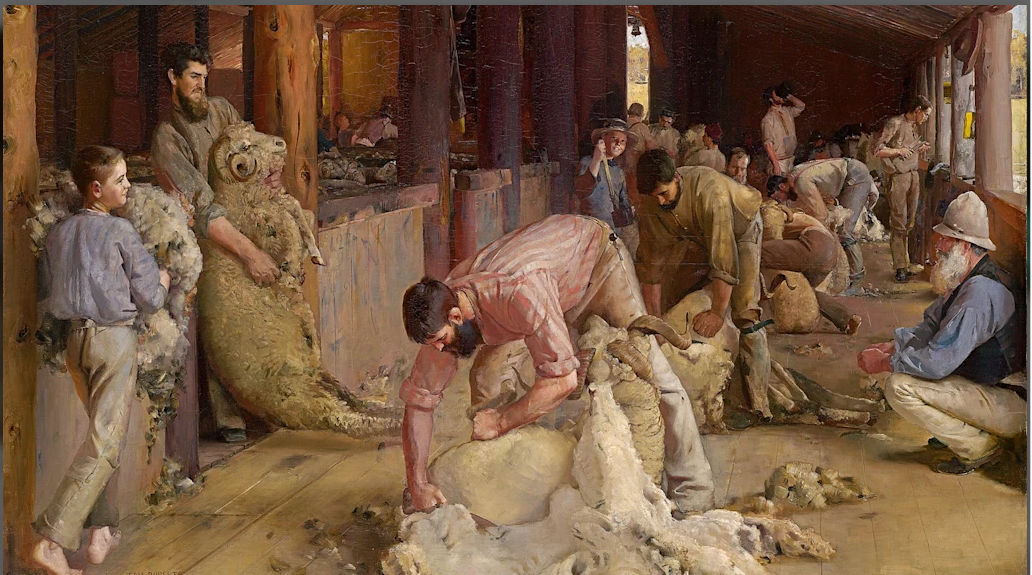
Both these paintings frequently pop up in books and on covers. One modern commentator said of Shearing the Rams that it ‘gives shearers the feel of figures from classical statuary’.4 I imagine the original founders of Trades Hall would have been happy with that. Their school’s former student ennobled the Australian worker for generations to come.
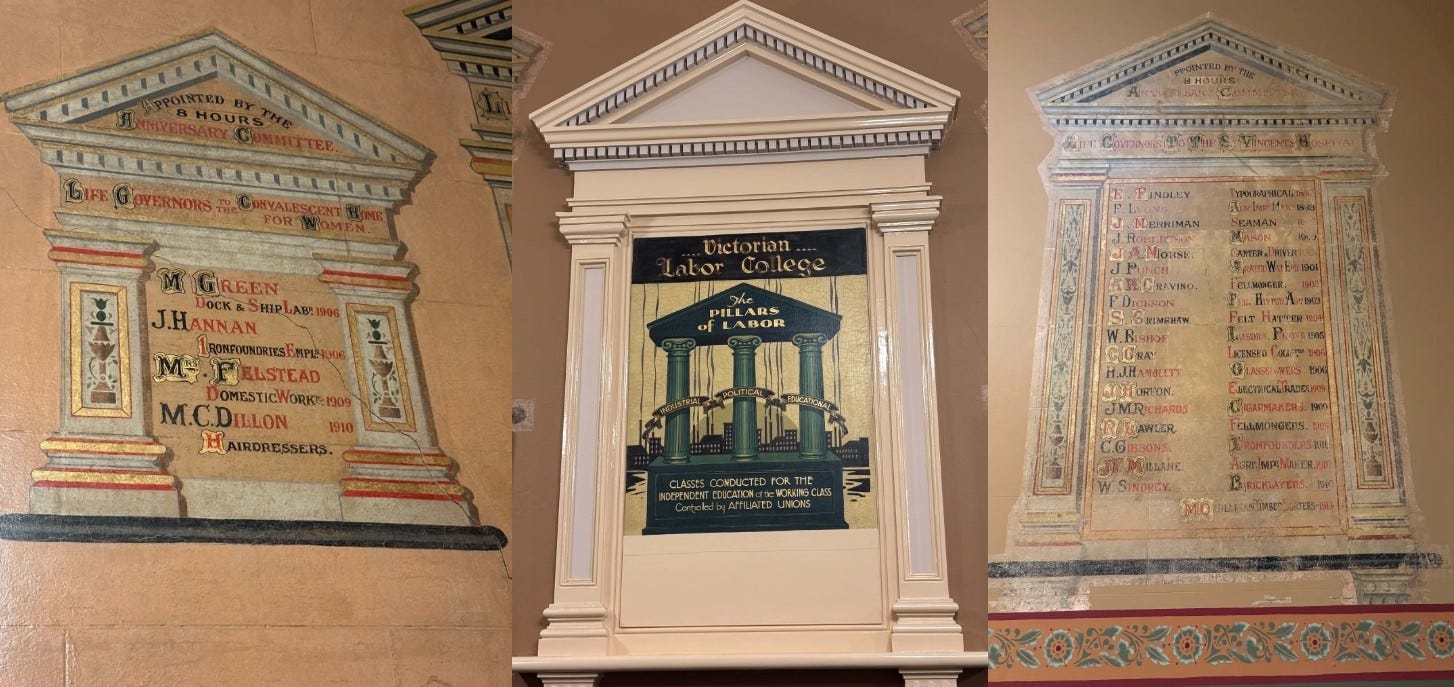
Just recently, a different aspect of social involvement by Trades Hall was literally uncovered during building renovations. Layers of surplus WWII khaki paint were gradually soaked off the Hall walls to reveal a series of honour boards. The boards list unionists involved in institutions, such as hospitals and convalescent homes.
Reds go Green
Later, in the 1970s-1980s, the Builders Labourers Federation (BLF) helped to save several heritage buildings built by their nineteenth century ‘888’ forebears. Ironically, the buildings included two banks. In their gilded splendour these banks are practically temples to high capitalism.
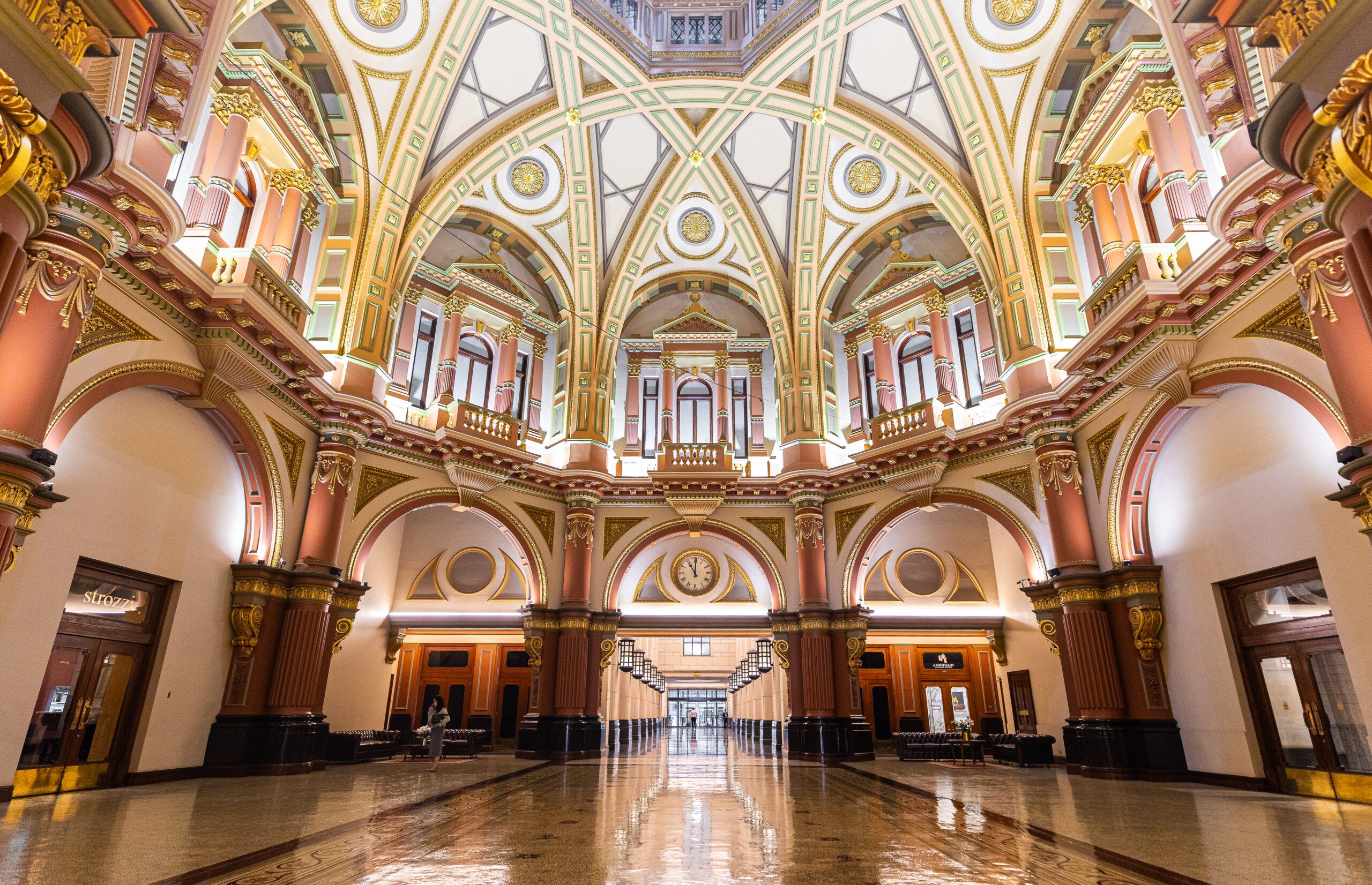
The BLF refused to work on these sites, halting development. This tactic became known as ‘green bans’, after it was used to preserve parklands. A German activist visiting Australia was impressed. Petra Kelly took the term home with her, and founded the German Green Party in 1980. Thus, a new colour was added to the world’s political rainbow, via the Australian trade unions 🌳.
So far, you might be forgiven for thinking I’m an advocate or apologist for the unions. I’m not. It’s just that I found this history surprising. It doesn’t fit the common perception of unionists as anti-establishment and low-brow. Unlike this sort of thing:
The parasite puppets of capital
Doin’ the foreign monopolies’ will
These maggots with blood of slime
Debauched in the rich man’s wine…

From ‘Kick Up a Storm, Free Norm’ by staunch BLF member George Despard
Bleh. A one-eyed, dehumanising rant that doesn’t rhyme or scan properly.
But All is not Roses
Our tour guide failed to mention that the ‘mighty BLF’ (her phrase), is not famous for its cultural contributions. Rather, it’s infamous – for its Marxist militancy and bloody-mindedness. And its ignoble end.
‘The Federation has continued to flout every accepted convention on which the Australian system of industrial relations depends... The union is clearly only interested in using every available avenue to threaten, intimidate, coerce and weaken the resolve of all those engaged in the building industry…The Government cannot allow the threat to the Australian conciliation and arbitration system, to the building industry and to its workers posed by the behaviour of the BLF to continue.’
Those are the words of a Labor minister (left-wing, in Australian politics).5
The union was deregistered in 1986. Shortly afterwards, its Secretary was convicted of corruptly receiving commissions.
Mr Vale of the Artisan School was right, that knowledge is power. I’d say that power clearly went to the head of the BLF leadership. Education doesn’t change the flaws in human nature. But it can give us better lives, art, architecture, and a heritage of human stories.
‘The wise have eyes in their heads, while the fool walks in darkness…
But the same fate overtakes them both.’
Ecclesiastes
As always, I’d love to hear your thoughts. Email me back, or hit the button below.
8 Bob equals 8 shillings.
The author of this poem is journalist and 8-hours advocate Charles Bright, but I haven’t found a date for it.
Ralph Willis, recorded in Hansard, 8 April 1986
Lovely article, which made me sigh a little for what we've lost. Yes, the trades union movement (and associated socialism of all stripes) has often suffered from corruption, but then so do all forms of government. At least there was a realization that knowledge, education, aspiration, and struggle on the part of the working classes were the necessary counterbalance to the tendency of elites to arrange matters so that they become richer at the expense of others. I'm just not seeing that sense of pride in work these days, nor the willingness to learn! But that aside, I'm loving this glimpse into the splendid art and architecture of 19th and early 20th century Australia, and into the history of your wonderfully vibrant city. I hope to return someday!