
You know those moments when you seem to step through time? This week, I was in the library researching for my novel.* I lost at least half an hour poring over colour plates of nineteenth century artists who painted in my area. A wistful shaft of light and peace filtered into me. To join me in this reverie, read on.
The suburb next to me happens to be where a famous Australian art movement got going. I mentioned the artists last month, when I wrote about the cultural contribution of early unions. Now you’re getting the full panorama.
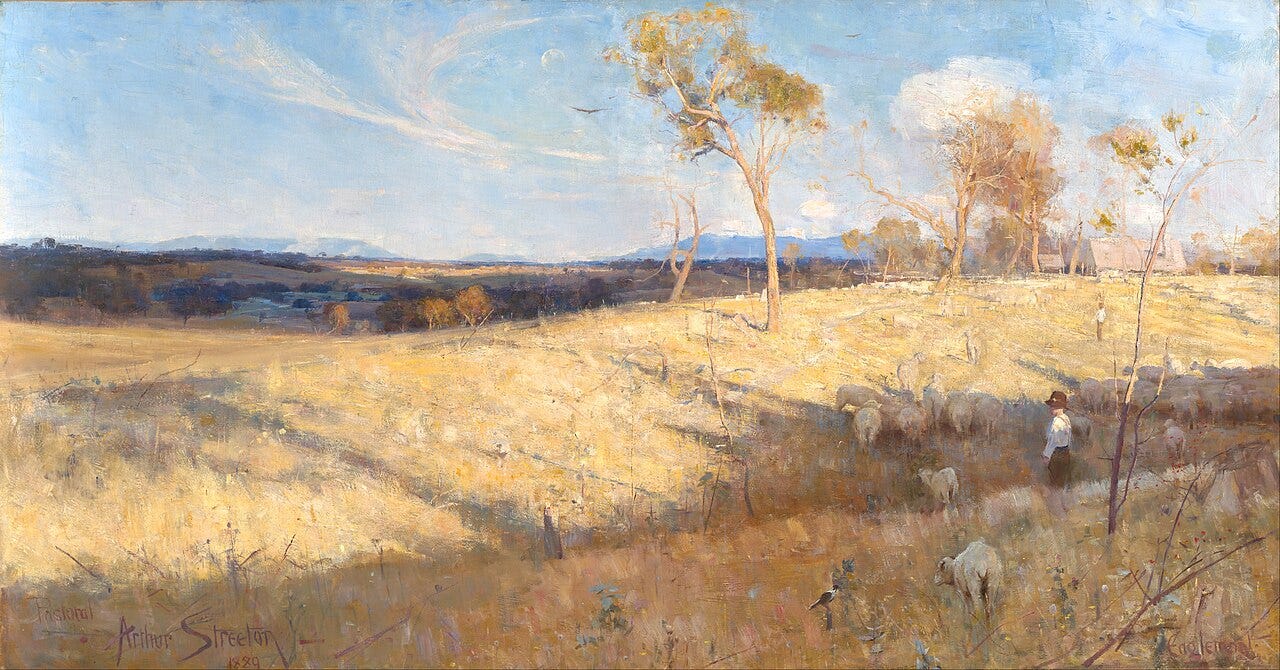
Not all Impressionists were French
In 1885, a friendly and enthusiastic Australian artist, named Tom Roberts, returned from Europe. He brought a head full of Impressionist ideas to Australia. He gathered other young painters into excursions to the country around Melbourne, to paint en plain air. By the summer of 1888 (when my novel is set), the artists had set up camp.
‘The old weatherboard homestead…was creaking and ghostly. A long dark corridor seemed full of past visions, and out of doors a blurred rich blackness against the sharp brilliance of the Southern Cross [constellation]… But tobacco and wine weighed healthily against the darkness.’
Arthur Streeton, of the abandoned Eaglemont homestead used as the artists’ base, in Heidelberg, Victoria.
Roberts, Streeton and Conder lived at the abandoned homestead. They were sometimes joined by Fred McCubbin, Walter Withers and others.


Life together at Heidelberg was rough and ready, but productive.
Conder and Roberts shared my solitary home. Our beds we made of cornsacks nailed to two saplings… our seats were old boxes… our leg of mutton, potatoes and so forth were all cooked together in a large pail. Our illumination was tallow candles. Surrounded by the loveliness of the new landscape, with heat, drought, and flies, and hard pressed for the necessaries of life, we worked hard, and were a happy trio.’
Arthur Streeton
The artists’ work culminated in an 1889 exhibition in downtown Melbourne. It was called the ‘9x5 Exhibition’, because it featured 183 oil paintings done mostly on cedar cigar box lids (in those dimensions). Very bohemian.


How were these adventurous artworks received, on the other side of the world from the European art scene?
The colony’s best known art critic said that four-fifths of the paintings ‘pain the eye’. The artists took his words on the chin, with ebullient confidence.
‘This criticism was so violent that we pasted it up at the street entrance to our exhibition. The people thronged to view the dreadful paintings.’
Arthur Streeton
But this isn’t a tragic Van Gogh story of unrecognised genius. (Find that in Beauty is Truth, an excellent Substack.) The public took a liking to the new art. All the paintings were sold. The ‘dreadful paintings’ and their painters became famous as ‘the Heidelberg school’.
Modern art critics are kinder about innovative style. Although they are also fond of tarring the painters with the brush of Australian nationalism. The Heidelberg school glorifies pioneer myths, is the argument.
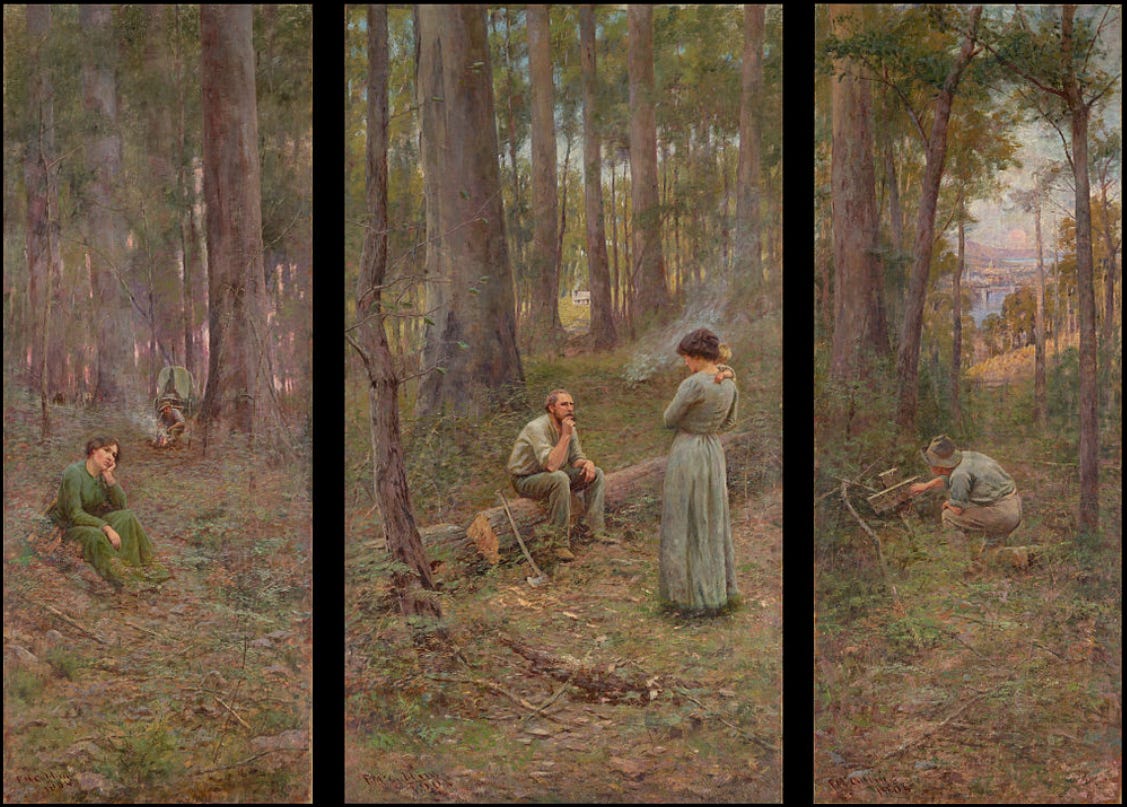
Looking at Fred McCubbin’s ‘The Pioneer’, one of Australia’s most famous paintings, you can see what they’re getting at. It’s no accident this was painted in 1904, only three years after Australia became a new nation. The triptych shows the impact this symbolic colonial trio — husband, wife, son — have had on the land over time. The family have a kind of dignity in their labour and their togetherness. But so do the stately trees in the brooding bush around them. The city shines in the distance, but in the foreground is the quiet reality of death. It’s not a triumph of human over nature. It’s a more complex and contemplative story.
Writing about the Heidelberg School, prominent twentieth century critic Robert Hughes said:
‘People long for old virtues. They [the old virtues] go easily into art because they have them at the back of their mind.’
Robert Hughes, ‘The Art of Australia’
My thought is — old virtues aren’t necessarily bad or outdated. There is something soul-stirring about ‘the rigour, the pathos and the heroism of the life that is about them’, as one critic said of Australian art in 1890.
However, nationalism wasn’t the original goal of Roberts, Streeton, Conder, McCubbin and their artist friends. Tom Roberts explained, ‘We went to the bush, and, as was always our ambition, tried to get it down as truly as we could.’
‘TO THE PUBLIC
‘An effect is only momentary: so an impressionist tries to find his place. Two half-hours are never alike… So in these works it has been the object of the artists to render faithfully, and thus obtain first records of effects widely differing , and often of very fleeting character.’
Statement from the 1889 9x5 Exhibition catalogue
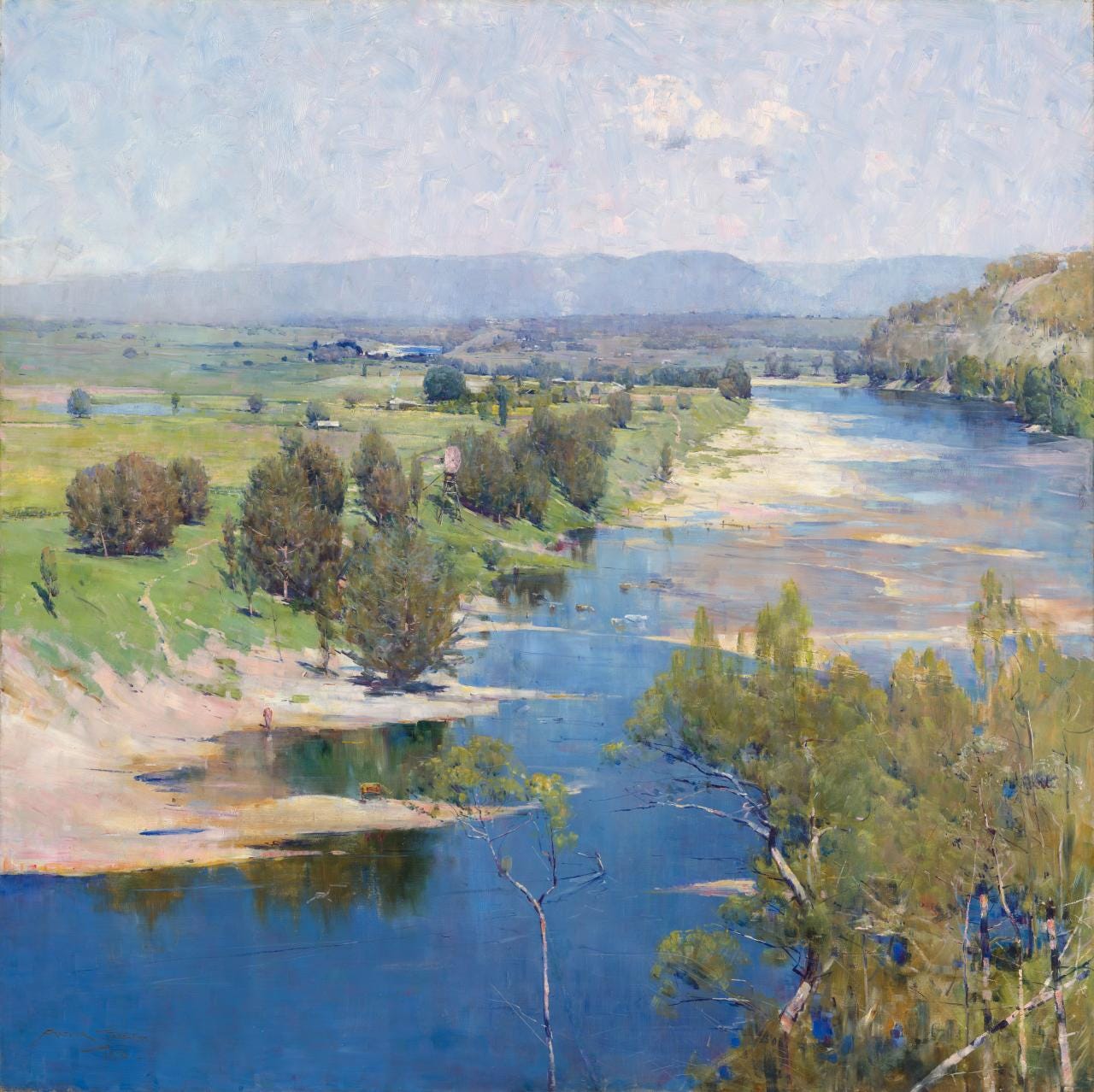
Streeton later wrote to Roberts, in 1893 , that he wanted ‘to try something entirely new… to translate some of the great hidden poetry’ of inland Australia. Sounds to me like these artists were moved by a beauty they felt to be mysterious, extraordinary and deeply meaningful.
I’m disappointed this is not the case in today’s art world. I went to a local exhibition earlier this year, close to where the Heidelberg school painted. The Edwardian building and the views were very enjoyable. The art was determinedly unattractive. It was deliberately unsettling, angry, off-kilter and weird. I left feeling a dissatisfied unsettledness of my own. I don’t see how that’s a healthy way of sustaining one’s soul.
Let me take you back to the Heidelberg school instead.
Fiction Update
*Where is the novel at? I’m redrafting. (Capturing fleeting moments on the page takes a lot of work.) I had to restructure when I realised someone acted completely out of character at the climax. Just for fun, as a kind of homage, Arthur Streeton now makes a cameo appearance halfway through.
If you like this content, I suggest…
Please give this email a like! Why? The dreaded algorithm has got its tentacles into email inboxes. If Gmail doesn’t think readers are interested, these emails will disappear down everyone’s feed, or into ‘promotions’. ‘Like’ this post (at top or bottom) to see similar stories in future.
Your comment, reply or share will likewise feed the algorithm beast. And ensure you a healthy diet of uplifting and enlightening history and fiction. 😀
A lovely article, Alison, and so interesting to see how impressionism translated to the wide open spaces of Australia. Such beautiful pictures!