
A riddle for you: what everyday item has been around for millenia, but was popularised by the Victorians?
Good ol’ Victorians. Through research for my stories, I’ve noticed this: whatever we think about their sexism and their imperialism, the people of the Victorian age were incredible innovators. All kinds of things that had been for the elite only — education, lace, wallpaper, voting — became available to ordinary people in the nineteenth century.
So back to the riddle. It’s the subject of this newsletter — what everyday item has been around since the Stone Age, but reached millions of homes in Victorian times? I’ve made a prize (below) when you get it. 😊
Hint: it’s literally an every day thing…
Hint #2: you probably got a new one recently…
Hint #3: it’s 12 pieces of art for the price of one…
Hint #4: it’s not just art; it has a practical purpose…
You’ve probably guessed by now. Or else your eyes have slid down the page and found the answer.
The answer is…
A calendar.
I love calendars. Come December-January, I shop for a new one to enjoy all year long. 2025 was William Morris designs. In 2026 I’ve gone for medieval illuminations from the British Library. Partly, I like the art. Partly, it just feels meaningful to mark the year, literally.
Humans have been fascinated with the passage of time for ages. A 12,000 year old carving, discovered on a pillar in Turkey, has 365 V-shaped symbols, thought to be arranged in 12 lunar months plus 11 days.
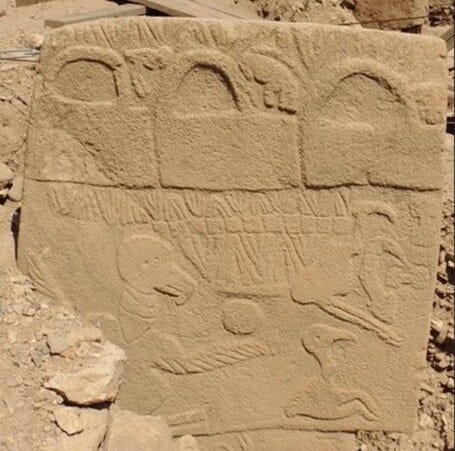
As another very old text, from a nearby part of the world, puts it:
And God said, “Let there be lights in the expanse of the sky, to separate the day from the night, and let them serve as signs to mark seasons and days and years.”
Genesis 1:14
An Illegal Calendar?
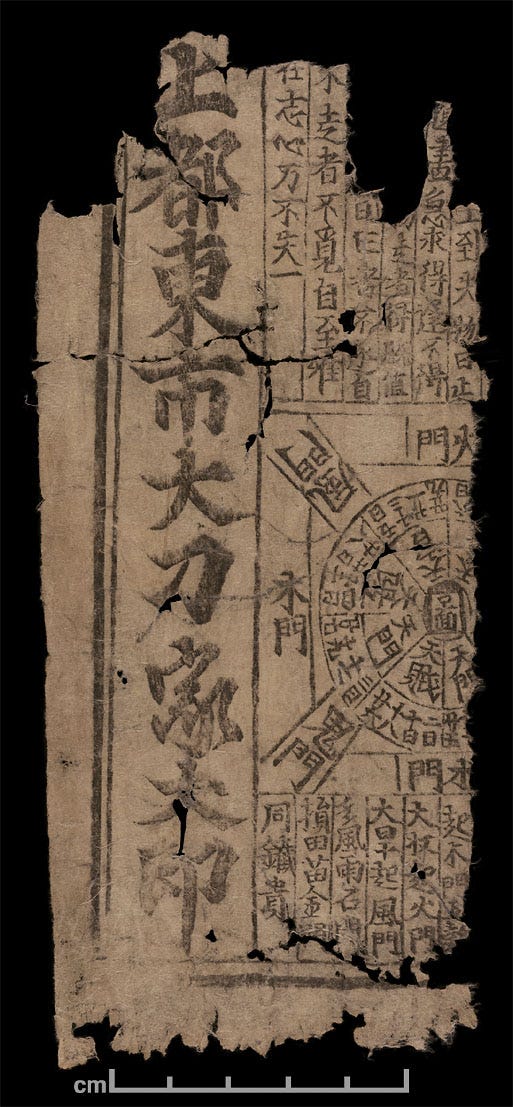
Our calendars aren’t likely to last like the Turkish one, given that they’re paper or digital. The oldest surviving printed calendar was found out in the Gobi desert, in Dunhuang, China.
In stylish calligraphy, the title reads: “East Market of Shangdu [the capital] Da Dao family large printing.” Da Dao means ‘Big Knife’ and isn’t a usual Chinese surname — maybe a large and powerful clan? A Tang Dynasty triad?
The British Library has dated the calendar to the ninth century. Interestingly, in 835 the Tang emperor banned the private printing and ownership of calendars. Why go that far, you might wonder? Because the Emperor was ‘the Son of Heaven’, and his role was to reinforce cosmic balance. If he got things wrong, the heavens might show their displeasure, through a comet or an eclipse. Astronomical knowledge and predictions were therefore highly political.
The Library’s not sure whether this calendar was printed before, or after, the prohibition. Possibly, it’s an illegal calendar. If it was, the Big Knife family weren’t afraid.
Calendars in Colour
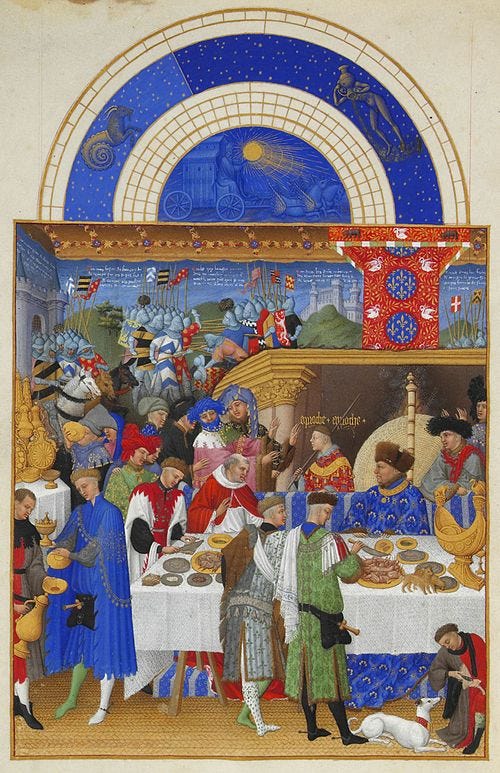
Medieval Europe has gifted us some gorgeous calendars, which were included in aristocrat prayer books. They were not mass printed, but individual works of art.
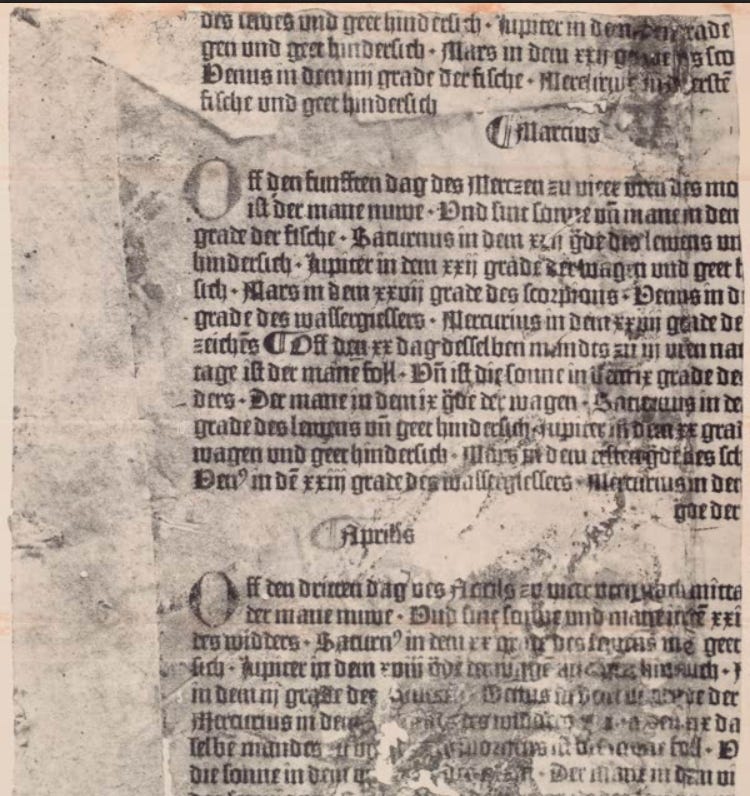
A calendar was one of the first items printed by Johannes Gutenberg, when he began printing with movable type later in the fifteenth century. But it’s not much to look at — very dense and blurry Gothic text. No pictures. No room to write in your friend’s birthday.
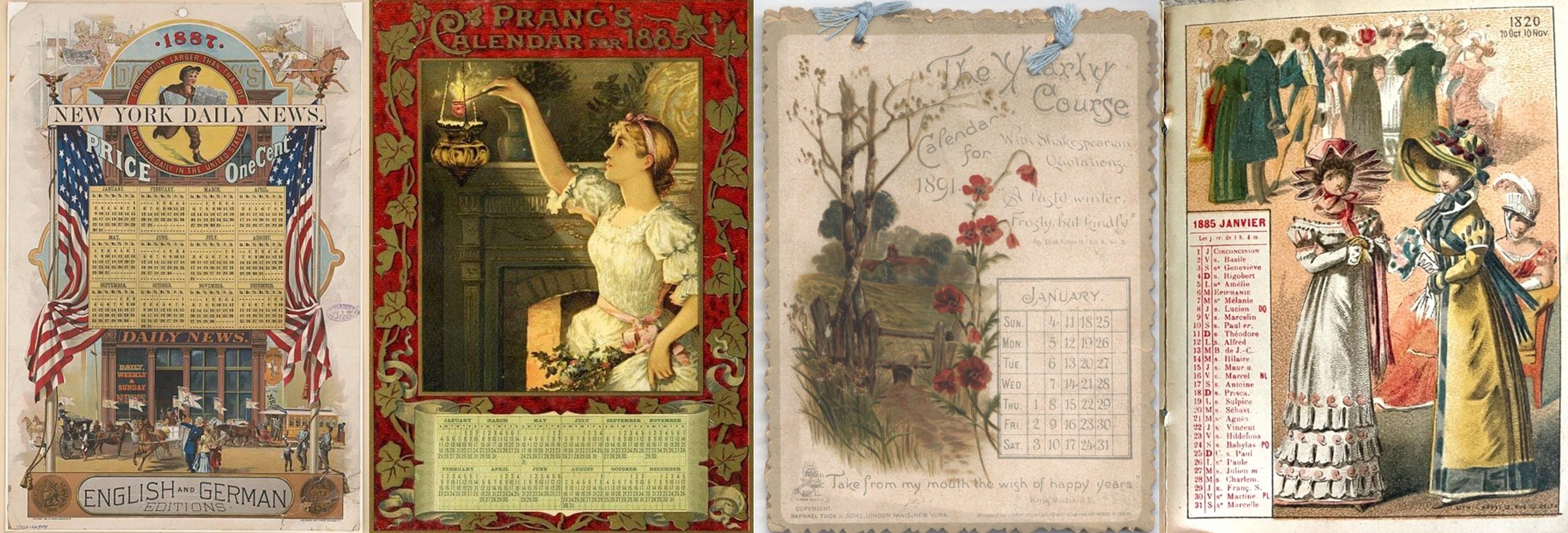
Eventually, nineteenth century innovations in colour printing (and advertising!) finally brought us pin-up calendars. This is a late Victorian selection:
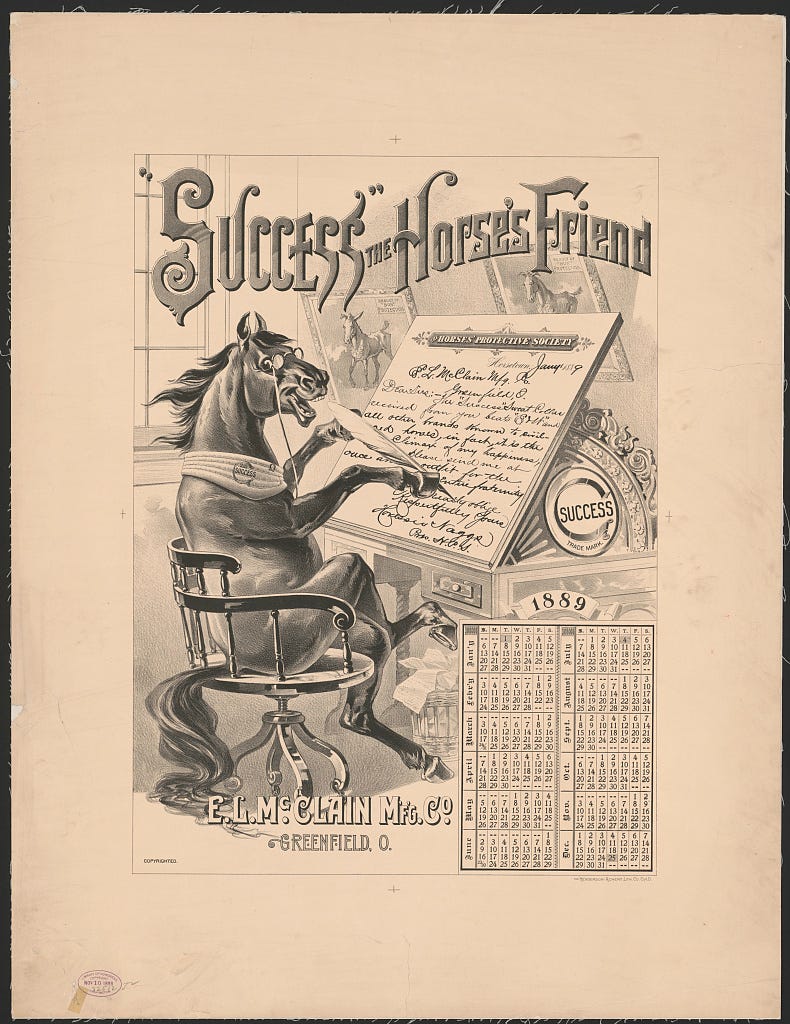
And here’s a fun one from 1889, which deserves a prize for imaginative advertising:
Your Prize!
I promised you a prize, for figuring out the riddle. Here you go — click on the image below, and you’ll get a pdf that you can download and print at home. (Two options). What use is a 150 year old calendar? It just so happens that 1885 had the same configuration of days and dates as 2026. So this calendar is good to go again this year. History does repeat! Sort of. You can’t buy stationery at Thomas Groom and Co anymore. But you can enjoy this repurposed freebie.


Timely Thoughts
Supposedly, calendars help us plan. They look deceptively empty and spacious, as if you’ve got so much time to get everything done. I sat down with my new calendar just recently, to determine this year’s goals and work. Maybe you’ve been doing the same. I wanted to tell you something like, ‘This year I’m going to self-publish my 1888 telephone exchange novel, and re-release some kids books!’ Some kind of plan to get excited about. But after a distracted December, I realised I’m not ready to set that timetable. I’ve given myself January to consider.
This quote, from Moses, has been percolating through my thoughts:
Teach us to number our days aright, that we may gain a heart of wisdom.
Psalm 90:12
Why should we number our days? Not to cram in more determined, or mindless, activity. But so we gain wisdom — see the scale of history, and our own span within it.
It helps me to profoundly respect the One who’s ‘from everlasting to everlasting’, unlike our finite selves. When I do that, my whirligig of busy thoughts slows. I feel a space open up inside. I don’t fret that the months are flicking over at a speedy clip. I know who’s in ultimate control, and it’s not me. I can put my plans on hold for a bit, and enjoy the calendar for its pictures.
What about you — did you guess the riddle? What’s on your 2026 calendar?
Wishing you a happy new year,
Alison
Your posts are full of interesting information. This year I want to enjoy each moment knowing it will come and go as surely as I will disappear one day. Thanks for the 1885 calendar.