
The crew in Artemis II have just been to the far side of the moon for the first time. But the moon has been inspiring us for millennia. I’ve pulled together a small collection of luminescent language and lunar art for you. Call it a lunar survey if you like 😉
The moon has always stirred human longings. What can beat a full moon for loveliness? Or moonlight’s uneasy shadows for eeriness? Here’s a post to transport you to the moon and back.
Let’s start in Ancient Greece. A Homeric hymn lavishes praise on the moon goddess:
Tell of the long-winged Moon… Bright Selene, having bathed her lovely body in the waters of Ocean, and donned her far-gleaming, shining team, drives on her long-maned horses at full speed… She is a sure token and a sign to mortal men…Hail, white-armed goddess, bright Selene, mild, bright-tressed queen!
(7th to 5th century BC, trans Hugh G. Evelyn-White 1914)
Whatever the moon is called — Selene, Artemis, Diana, Cynthia or Chan Juan — it’s almost universally a symbol of beauty.
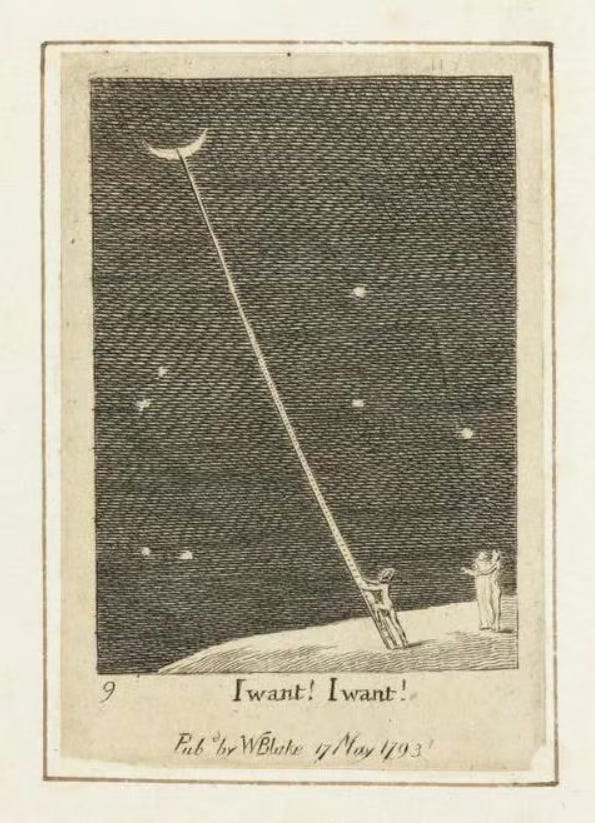
Just as often, as in William Blake’s etching, it reminds us of the unattainable. There is something about the moon’s ethereal light that makes us melancholy. ‘With how sad steps, O moon, thou climb’st the skies’, wrote English poet Sir Philip Sidney, in about 1582.
Shakespeare used the moon as a symbol of change and unreliability. In the famous balcony scene, Romeo is about to swear ‘by yonder blessed moon’, but Juliet stops him:
O, swear not by the moon, the fickle moon, the inconstant moon,
That monthly changes in her circle orb,
Lest that thy love prove likewise variable.’
(Oo, what enchanting assonance! And those murmuring ‘m’s and ‘n’s…)
In Henry IV, Falstaff suggests to the Prince that they act under the moon goddess’s auspices. He is up to no good:
Let us be Diana’s foresters, gentlemen of the shade, minions of the moon, and let men say we be men of good government, being governed, as the sea is, by our noble and chaste mistress the moon, under whose countenance we steal.
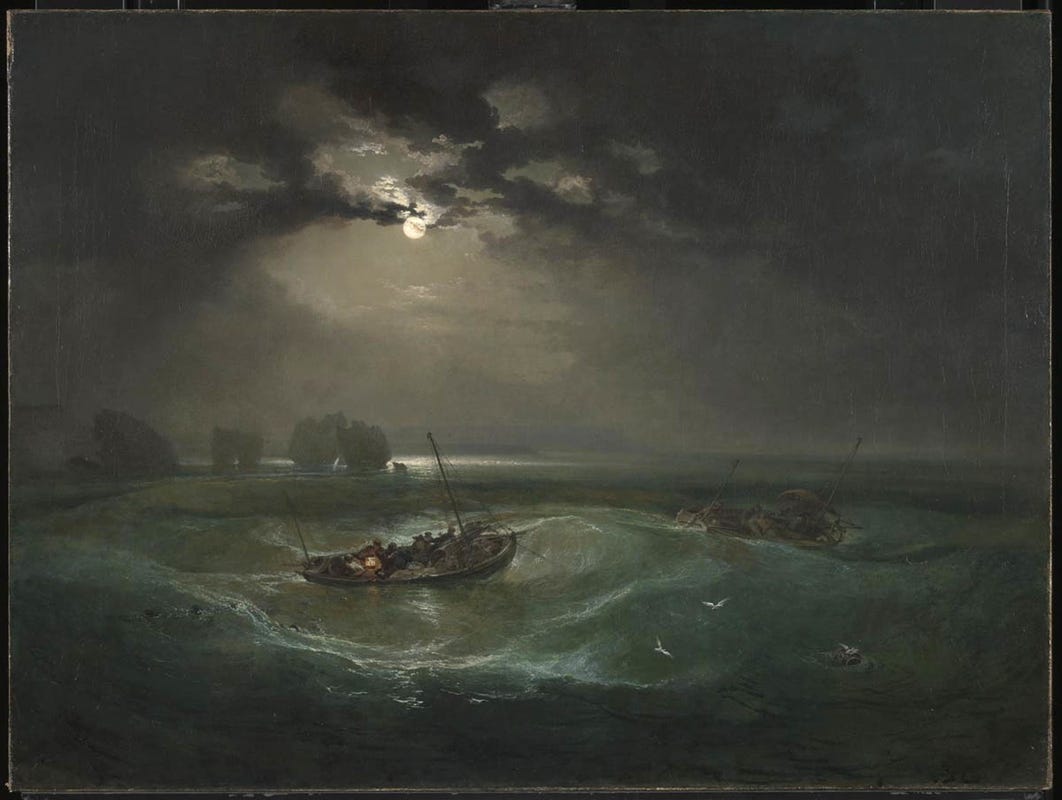
Similarly, in Alfred Noyes’ deliciously Gothic ‘The Highwayman’, from 1904, the moon adds to the atmosphere of danger and foreboding:
The wind was a torrent of darkness among the gusty trees.
The moon was a ghostly galleon tossed upon cloudy seas.
The road was a ribbon of moonlight over the purple moor,
And the highwayman came riding—
Riding—riding—
The highwayman came riding, up to the old inn-door.
I learned ‘The Highwayman’ in primary school, and I still love its driving rhythm and melodramatic flair. It’s a tragedy, over which the moon rides high. Find it here, if you’d like to read the whole tale.
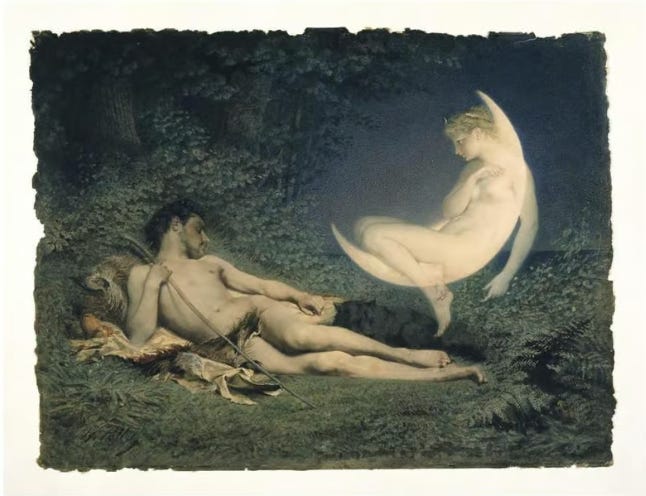
Alfred Noyes was a late Romantic. Romantic era poets loved to moon about in mythic allusions and lunar melancholy. Keats wrote a whole epic poem, ‘Endymion’, about the love of a shepherd for the moon goddess:
…‘Tis She, but lo!
How chang’d, how full of ache, how gone in woe!
She dies at the thinnest cloud; her loveliness
Is wan on Neptune’s blue: yet there’s a stress
Of love-spangles, just off yon cape of trees,
Dancing upon the waves…
It’s 4000 lines of rather fulsome, be-spangled poetry. A bit OTT.
Emily Dickenson, in comparison, is sparse, strange and striking. In ‘The Moon was but a Chin of Gold’, maybe she’s being humorous. Or maybe she’s not?
The Moon was but a Chin of Gold
A Night or two ago—
And now she turns Her perfect Face
Upon the World below—…Her Bonnet is the Firmament—
The Universe—Her Shoe—
The Stars—the Trinkets at Her Belt—
Her Dimities—of Blue—
(Her what? Dimity was a lightweight cotton fabric with cords or ribs running through the cloth. As far as I can discover, the cloth was used for bedlinen, and underwear. So I think that Dickenson is saying the moon wears the sky next to her skin. It is a rather unsettling juxtaposition — homely and celestial at the same time. I can’t tell if she’s joking.)
Half a century later, T E Hulme strips the moon of mythic status, or human likeness, and brings it down to earth, caught in the trees. But I think there’s still something poignant about this moment, a fragility, of something about to be lost, as the balloon floats away or bursts…
Above the quiet dock in mid night,
Tangled in the tall mast’s corded height,
Hangs the moon. What seemed so far away
Is but a child’s balloon, forgotten after play.
(’Above the Dock’, 1912)
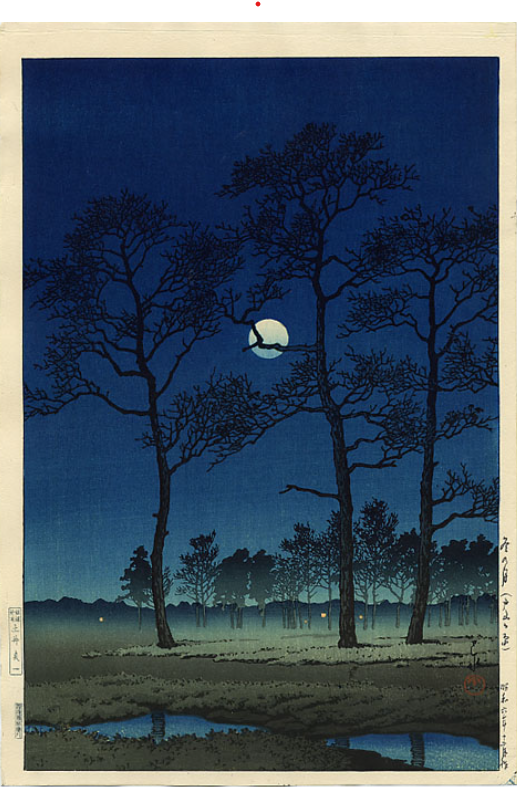
Moving further forward into the twentieth century, Keats’ Romantic sentimentality totally disappears. Sylvia Plath wrote a poem called ‘The Moon and the Yew Tree’:
This is the light of the mind, cold and planetary.
The trees of the mind are black. The light is blue.
The grasses unload their griefs at my feet as if I were God…
The moon is my mother. She is not sweet like Mary.
Her blue garments unloose small bats and owls…
She is bald and wild…
So heavy, all those alliterative ‘d-d-d’ sounds. It’s a bleak moon, the one that filters into Sylvia Plath’s mind.
I would rather not leave you there. Let me finish instead with a famous Chinese poem, which manages to bring longing and loveliness together in one paradoxical moment.
In 1076, under the full moon of Mid-Autumn festival, Chinese poet Su Shi wrote ‘Prelude to a Water Melody’. He was thinking of his faraway brother, celebrating the festival in another province. Chinese poetry is near impossible to translate into English because the original is so compact, but here’s my best effort:
People have grief and joy — we part; we meet;
The moon is dark or bright, round or incomplete;
In this world, perfection is hard to reach.
But let men wish for forever;
A thousand miles away, under the moon together.
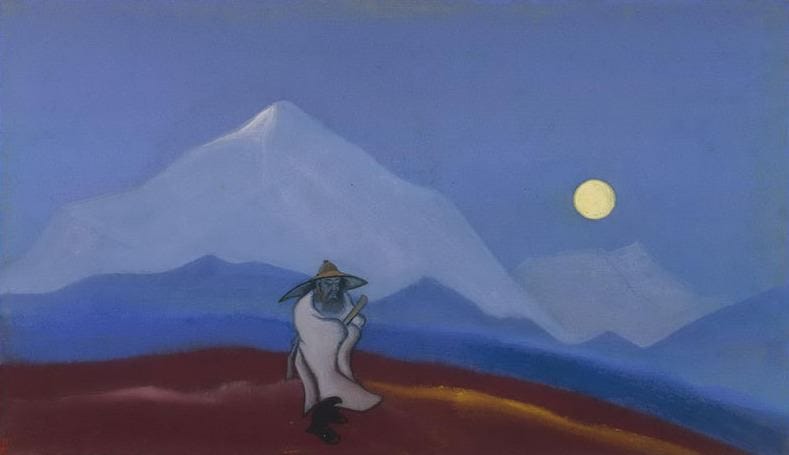
May the moon call you to higher thoughts too. Until next month!
If you enjoyed this Scroll, feel free to share it with a friend, or share your thoughts.
P.S. Thank you to the readers who joined me for the Lent series. We were a select group, but I always appreciate company here!
What a lovely article! I particularly liked the Noyes poem, which I had never come across before, but enjoyed all your poetry and art.